Introduction
What is REF Protection?
Restricted Earth Fault (REF) protection is an important safety feature for power transformers. Its primary role is to spot internal earth faults that could seriously harm electrical equipment. REF protection does this by keeping an eye on unbalanced currents that happen when there’s an electrical fault. These currents include both phase currents and the neutral current. When a fault occurs, REF protection jumps into action, quickly identifying the problem and disconnecting the transformer from the rest of the system. This prompt response helps prevent major damage and keeps electrical systems running smoothly.
Why Understanding Power Transformers Matters
Power transformers are essential in the world of electrical engineering. They play a key role in changing voltage levels within power distribution systems, allowing electricity to flow efficiently over long distances. Without transformers, the voltage levels wouldn’t be safe or suitable for everyday use in our homes and businesses. By grasping how power transformers work, engineers can implement effective protection strategies that maintain both reliability and safety. This knowledge helps ensure that electrical systems function properly, avoiding interruptions or damages.
Understanding REF Protection
How REF Protection Works
The mechanics behind REF protection are pretty straightforward. Essentially, it detects the difference in current levels inside the transformer. This involves measuring the variations between phase currents and the neutral current. When everything is balanced, the transformer works like a charm. However, if something goes wrong and causes an imbalance, the REF protection system quickly activates. This rapid detection is crucial for isolating faults and preventing damage to the transformer, as well as ensuring the safety of the surrounding electrical systems.
The Role of REF Protection in Fault Detection
REF protection’s main job is to keep an eye on potential internal faults within the transformer. An internal winding fault can generate a lot of heat and stress, placing the insulation at risk and potentially leading to serious failures. If such a fault occurs, the REF protection responds quickly by detecting any imbalances in the electrical currents. This fast identification triggers an immediate isolation of the fault, which is vital in stopping the transformer from causing larger issues within the power system. REF protection’s ability to swiftly detect and tackle faults reinforces its importance in keeping transformers safe.
Types of Transformer Faults
Internal Winding Faults
Internal winding faults are among the most significant problems that can happen in power transformers. These faults occur within the transformer windings, where electrical connections may fail or insulation can degrade. Such issues can lead to serious operational challenges and threaten the entire electrical system. REF protection is tailor-made to accurately identify these faults by monitoring the currents within the transformer. Its sensitivity is crucial for ensuring that these faults don’t escalate into larger, more destructive problems.
High-Resistance and Low-Magnitude Faults
High-resistance and low-magnitude faults can be tricky to detect. Unlike larger faults that cause major imbalances, these smaller issues create only subtle shifts in electrical currents. Fortunately, REF protection is sensitive enough to pick up on these tiny changes. By using this capability, it can catch potential problems that might otherwise slip through the cracks. Early detection is vital for maintaining transformer reliability and performance, and focusing on high-resistance and low-magnitude faults ensures that all potential concerns are addressed promptly.
Preparing for Installation
Assessing Electrical Systems
Before jumping into installing REF protection, it’s important to conduct a thorough assessment of the electrical systems. This involves checking how well existing systems align with the requirements for REF protection. Engineers should analyze various factors, like voltage levels, grounding configurations, and the layout of electrical components. Understanding these elements ensures that the REF protection system integrates smoothly into the overall electrical setup. This preparation also helps spot any potential hiccups that could arise during installation, leading to a more efficient process.
Setting Up CT Connections and Neutral Current Transformers
Connecting Current Transformers (CT) is a key step in installing REF protection, as they measure the phase currents flowing through the system. Properly connecting these transformers is essential for accurate current monitoring. Additionally, the setup of a Neutral Current Transformer (NCT) is just as important, as it tracks the neutral current to maintain balance in the system. Together, these connections support the operational efficiency of REF protection. It’s crucial to get the CT and NCT connections right to ensure proper current flow monitoring.
Installation Steps
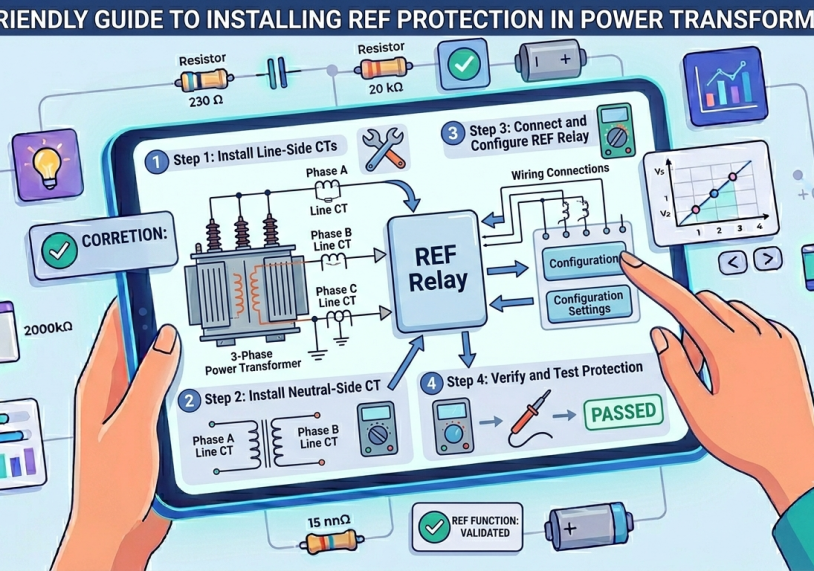
Step 1: Setting Up the Protective Relay
Once you’ve covered the preparation phase, the first installation step is configuring the protective relay. This relay is the heart of the REF protection system, and it must be tailored to the specific needs of the transformer it’s protecting. Each transformer has its own unique settings based on its voltage levels and operational characteristics. During this configuration process, engineers calibrate the relay to respond accurately to the measured currents, establishing response thresholds and time delays. Proper configuration is essential for the relay to work effectively, aiming for top-notch fault detection and protection.
Step 2: Testing Relay Sensitivity
After setting up the protective relay, the next step is testing its sensitivity. This is crucial to ensure the relay reacts appropriately to fault conditions. Engineers simulate various fault scenarios to see how the relay responds. A highly sensitive relay is better equipped to catch minor faults that may lead to significant damage. By fine-tuning the relay settings based on these tests, engineers can optimize the system for effective protection. Testing the relay’s sensitivity also boosts confidence in the REF protection system, ensuring it performs as expected in real-world conditions.
Protection Schemes
Sensitive Earth Fault Protection
Sensitive earth fault protection takes the REF principles a step further by focusing on even the tiniest earth faults. This specialized application closely monitors low current levels, providing a cost-effective way to protect power transformers. It’s incredibly beneficial because it can detect faults that might otherwise lead to extensive downtime or expensive repairs. Implementing this type of protection is vital in environments where reliability and performance are key.
Generator and Busbar Protection Strategies
In addition to REF protection, there are other significant protection schemes, like generator and busbar protection. These methods share a common foundation with REF protection, aiming to bolster the overall reliability and safety of electrical systems. Generator protection safeguards against faults that could affect the generators, while busbar protection monitors the systems that distribute power among various circuits. By combining these strategies with REF protection, engineers can create a well-rounded safety framework. Having multiple layers of protection is essential for preventing faults and ensuring everything operates smoothly within electrical networks.
Operational Considerations
Addressing Unbalanced Currents and Residual Current
Unbalanced currents can signal significant challenges for power transformers, indicating issues that need prompt attention. REF protection excels at detecting these imbalances, enabling early fault detection. Monitoring residual current is equally crucial, as it helps catch anomalies before they turn into serious problems. By focusing on these aspects, REF protection enhances its role in keeping transformers healthy and performing at their best. Engineers must consider unbalanced currents when designing effective protection systems.
Understanding High-Impedance Grounding in Unearthed Systems
High-impedance grounding is a technique often used in unearthed systems to improve safety. This method helps limit fault currents, enhancing safety for both personnel and equipment. However, it’s vital to ensure REF protection remains effective in these scenarios. The design of the REF protection system should be adaptable to high-impedance grounding without sacrificing sensitivity. This flexibility ensures reliable protection, no matter the grounding method used in unearthed systems.
Conclusion
Recap of Installation Steps for Success
To summarize, installing REF protection involves several key steps, starting with a thorough assessment of the electrical system to ensure it meets REF requirements. After that, configuring the protective relay is crucial, followed by sensitivity testing to guarantee effective fault detection. Each of these steps plays a significant role in the overall success of transformer protection. By following this structured approach, engineers can set up a robust system that efficiently safeguards power transformers.
Promoting Safety and Reliability in Electrical Engineering
Implementing REF protection is critical for ensuring safety and reliability in the field of electrical engineering. This system greatly enhances fault detection and isolation in power transformers. By adhering to the outlined installation steps, engineers can establish a reliable protection mechanism that safeguards the entire electrical system. Prioritizing REF protection is essential for maintaining both the integrity of power transformers and the larger electrical network they support. A well-installed REF protection system not only provides peace of mind for operators but also leads to significant long-term savings by preventing costly faults.
References
- https://www.linkedin.com/pulse/sef-ref-protection-applications-atiq-ur-rehman-q562chttps://www.electrical4u.com/restricted-earth-fault-protection-of-transformer-ref-protection/
- https://elec-engg.com/restricted-earth-fault-protection-in-transformers-generators/
- https://electrical-engineering-portal.com/power-transformer-protection-relaying-combined-differential-ref
- https://selinc.com/api/download/138122/
- https://electricalenggqna.quora.com/What-is-REF-protection-in-electrical-system-What-rating-of-motors-and-transformers-the-REF-protection-is-used-for
- https://www.megger.com/en-us/et-online/february-2022/understanding-generator-restricted-earth-fault-%28re
- https://www.quora.com/What-are-the-causes-of-a-restricted-earth-fault-of-a-transformer-both-side-star-winding
- https://www.eng-tips.com/threads/ref-nef-protection.146609/
- http://www.gozuk.com/forum/what-is-ref-restricted-earth-fault-protection-on-transformer-573354.html
- https://www.cedengineering.com/userfiles/Power%20Transformer%20Protection-R1.pdf
- https://www.linkedin.com/posts/itsawanzada96_power-transformer-installation-procedure-activity-7327605123923243008-CcTR
- https://site.ieee.org/fw-pes/files/2013/01/transfguide.pdf
- https://www.scribd.com/document/672479603/REF-Protection
- https://www.eng-tips.com/threads/application-of-ref-protection.203797/
- https://www.linkedin.com/posts/mdaliimam_power-transformer-installation-procedure-activity-7326314479837700097-LhAp
- https://www.quora.com/What-is-REF-and-SEF-protection-in-a-transformer-What-is-the-difference
- https://www.daelimtransformer.com/transformer-installing.html
Pingback: How a Surge Arrester Works, and What Insulation Coordination Means - Electrical Blog