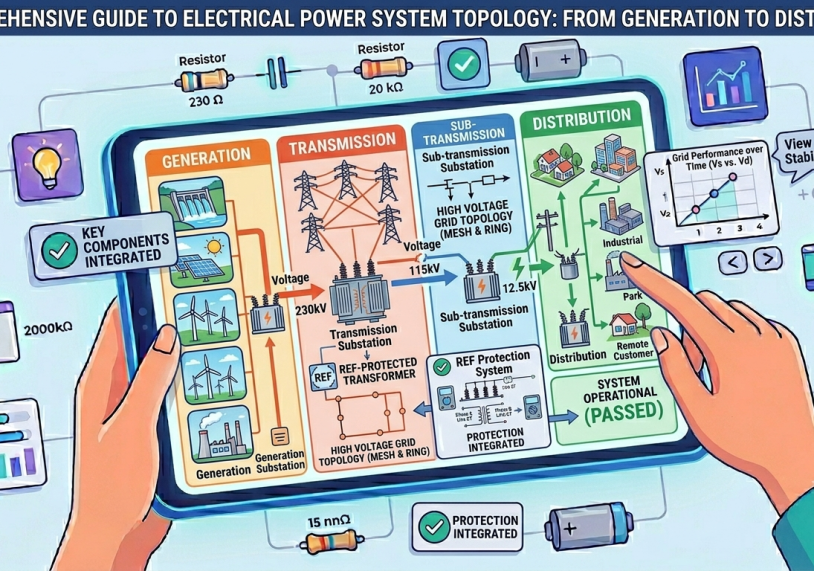
In the world of electrical engineering, the power grid is often described as the largest and most complex machine ever built by humanity. To understand, manage, and protect this machine, engineers rely on a specific visual language known as Electrical Power System Topology.
Whether you are a student or a seasoned professional, understanding how power flows from a power plant to a household outlet is the foundation of power system analysis.
What is Power System Topology?
At its core, topology refers to the arrangement of various elements (links, nodes, etc.) in a network. In an electrical context, power system topology is the map of how generating stations, transmission lines, and distribution centers are interconnected.
Because real-world three-phase systems are incredibly complex, engineers use a simplified representation called a Single-Line Diagram (SLD).
Why use a Single-Line Diagram?
A typical power system involves three separate phases (A, B, and C). Drawing all three wires for every connection would make a diagram unreadable. An SLD simplifies this by representing all three phases with a single line, allowing us to focus on the “topology” or the logical flow of power rather than the physical wiring.
Key Components of a Modern Power System
To grasp the topology of the grid, we must break it down into four distinct stages, as shown in our interactive animation below.
Electrical Power System Topology
Standardized Single-Line Diagram (SLD) of Generation, Transmission, and Distribution
1. Generation: The Source of Energy
Most power begins at a Power Plant. Here, mechanical energy (from steam, wind, or water) is converted into electrical energy using a synchronous alternator, (labeled G1 in our diagram).
- Standard Voltage: Typically between 11 kV and 25 kV.
- The Symbol: In academic diagrams, an alternator is represented by a circle containing a sine wave ($\sim$), signifying Alternating Current (AC).
2. Step-Up Substations (GSU)
Power plants are often located far from cities. To transport electricity efficiently over long distances, we must raise the voltage to reduce current- thereby minimizing I²R heat losses in the wires.
- The Component: The Step-Up (GSU) Transformer.
- The Symbol: Represented by two overlapping circles, symbolizing mutual induction between the primary and secondary windings.
3. Transmission Infrastructure (HV)
This is the “interstate highway” of electricity. High-Voltage (HV) transmission lines carry power at levels ranging from 110 kV to 765 kV.
- Topology Note: Transmission networks are often “meshed” (interconnected) to ensure that if one line fails, power can be rerouted through another path.
4. Distribution and the Load Center
Before electricity reaches your home or office, it must be “stepped down” to a safe level.
- Step-Down Substation: Lowers the voltage to sub-transmission or distribution levels (e.g., 13.2 kV).
- Load Center: The final destination where power is consumed by “loads” (industrial motors, HVAC systems, electronics). In our diagram, this is reduced to 480V or 230V/400V for end-use.
Why Topology Dictates Protection and Analysis
Understanding the topology is not just about drawing lines; it is about safety. The way a system is “mapped out” determines how we protect it.
- Overcurrent Protection: If a “fault” (short circuit) occurs on a transmission line, the topology tells the Circuit Breakers which sections to isolate so the rest of the grid stays online.
- System Analysis: Engineers use topology to perform “Load Flow” studies, ensuring that no single transformer or line becomes overloaded during peak demand.
- Balanced vs. Unbalanced Systems: While we often assume the grid is “balanced” (all three phases are equal), real-world topology must account for unbalanced loads, which can lead to heating and equipment failure.
Conclusion: The Evolving Grid
As we move toward a greener future, power system topology is changing. We are shifting from a “one-way” flow (power plant to consumer) to a “bi-directional” flow, where solar panels and electric vehicles (EVs) can feed power back into the grid.
Mastering the basics of the Single-Line Diagram is your first step in navigating this energy transition.