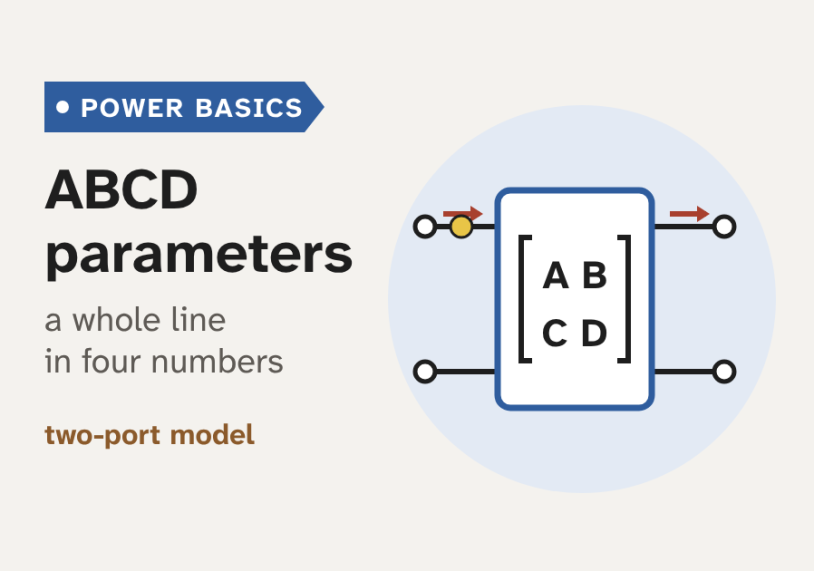
In this guide we treat a whole transmission line as one simple box with four numbers, and we use diagrams and a worked example to see what each number means.
Quick answer: ABCD parameters describe a transmission line as a two-port network. Two equations link the two ends: Vs = A·Vr + B·Ir and Is = C·Vr + D·Ir. A and D have no units, B is an impedance in ohms, and C is an admittance in siemens. For any passive line AD − BC = 1, and for a symmetrical line A = D. With the far end open, the receiving voltage is Vs/|A|, which is why long lines show the Ferranti effect.
Want to play with it? Our interactive ABCD parameters lab lets us change a line and watch A, B, C and D update. It works well next to this article.
Why treat a line as a box?
A transmission line can be hundreds of kilometres long. Along every metre, the wire has resistance and inductance. Between the wires, and between each wire and the ground, there is capacitance. So the voltage and current change a little at every point along the line.
We could describe all of this with equations for every metre. But a grid engineer usually needs much less. We need to know what happens at the two ends. How much voltage must the power plant side send? And what voltage and current arrive at the city?
So here is the question for this article. Can we replace hundreds of kilometres of wire with just four numbers? The answer is yes, because the line is linear. This means that if we double the current, the voltage drops also double. The animation at the top of the page shows the idea. We hide the line inside a box and look only at its two ends.
Think of a car gearbox. A driver does not need to know every gear inside. It is enough to know how the input shaft speed and torque relate to the output shaft. ABCD parameters do the same for a line. They tell us how the input end relates to the output end, and they hide everything in between.
The two-port model
A two-port network is any circuit with two pairs of terminals. Each pair is a port. For a line, port 1 is the sending end, the power plant side. Port 2 is the receiving end, for example the busbar of a city substation. The figure below shows the box and the four quantities at its ports.
At the sending end we have the voltage Vs and the current Is. At the receiving end we have Vr and Ir. Note the direction of the currents. Is flows into the box. Ir flows out of the box, toward the load.
Because the line is linear, the sending-end quantities are simple sums of the receiving-end quantities:
The same two equations in matrix form are:
These are phasor equations. A phasor is a complex number that holds both the size and the phase angle of an AC quantity. So A, B, C and D are complex numbers too. For a three-phase line we use per-phase values: the line-to-neutral voltage and the line current.
Putting the line-to-line voltage into Vs = A·Vr + B·Ir. The equations work per phase. So we first divide the line-to-line voltage by √3. At the end we multiply by √3 again to get the line-to-line answer.
What A, B, C and D mean
Each parameter has a clear physical meaning. We can find each one with a simple test at the receiving end. In the first test the receiving end is open, so no current leaves it. In the second test it is short-circuited, so its voltage is zero. The figure below shows both tests.
- A is a voltage ratio: . It tells us how the sending voltage compares with the receiving voltage when the line has no load. It has no units.
- C is a transfer admittance: . With no load, the line still takes a small current. This is the charging current of the line capacitance. C is measured in siemens (S).
- B is a transfer impedance: . With the far end shorted, B is the voltage needed to push one ampere through to the short. It is measured in ohms (Ω). For short and medium lines B is simply the series impedance Z.
- D is a current ratio: . It compares the sending current with the receiving current in the short-circuit test. It has no units.
So now we can read the first equation in plain words. The sending voltage is the no-load part, A·Vr, plus a load part, B·Ir. The load part is the voltage drop that the load current causes in the series impedance. It is Ohm's law, V = I·Z, applied to the line.
There are two quick checks that every correct ABCD matrix of a line must pass. The first holds for any passive, reciprocal network. Passive means it has no sources inside. Reciprocal means it behaves the same in both directions, which is true for lines, cables and normal transformers.
The second check holds for a symmetrical network, one that looks the same from both ends. A uniform line is symmetrical. So for a line:
Together, these two checks mean that a line has only three independent parameters, not four. So if a calculation gives AD − BC far from 1 + j0, there is an arithmetic error somewhere. But careful: a chain that includes a transformer at one end is not symmetrical. For that chain, A is not equal to D, and that is correct.
Short, medium and long lines
To find A, B, C and D we first need a model of the line. We start from the line constants per kilometre. The series impedance per kilometre is z = r + jx, where r is the resistance and x the inductive reactance. The shunt admittance per kilometre is y = jb, where b is the capacitive susceptance. For a line of length l, the totals are:
How we use these totals depends on the length of the line. The figure below shows the three common models side by side.
Short line (under about 80 km). The charging current is small, so we ignore the capacitance. The line is just a series impedance. The sending and receiving currents are equal:
Medium line (about 80 to 250 km). We use the nominal-π model. We put the whole series impedance Z in the middle, and half of the shunt admittance, Y/2, at each end. The circuit looks like the Greek letter π. Then:
Long line (over about 250 km). Now the lumped model is not accurate enough. The resistance, inductance and capacitance are spread evenly along the whole line. We solve the line equations exactly and get:
Here γ is the propagation constant, which tells us how the voltage changes per kilometre. Zc is the characteristic impedance, also called the surge impedance. For overhead lines it is about 400 Ω. Both come from the per-kilometre constants:
All three models pass both checks: A = D, and AD − BC = 1. The long-line formulas also contain the others. For a short enough line, cosh γl is close to 1 + YZ/2, and the exact model gives almost the same numbers as the nominal π. We will see this in the worked example.
Cascading: multiply the matrices
Real power reaches a city through several parts in a row. For example, a generator step-up transformer T1 raises 13.8 kV to transmission voltage. Then a line L carries the power. Then a substation transformer T2 lowers the voltage again. Each part is a two-port with its own ABCD matrix. We call such a chain a cascade.
This is where ABCD parameters are most useful. The output port of one block is the input port of the next. So the matrix of the whole chain is simply the product of the matrices, taken in the same order as the power flows. The figure below shows the idea.
For two blocks, matrix 1 followed by matrix 2, the product gives:
Think of changing money through several currencies on a trip. To find the total rate, we multiply the rates of each exchange in order. A cascade of two-ports works the same way. We multiply the matrices of each block in order, and we get one matrix for the whole trip.
Multiplying the matrices in the wrong order. Matrix multiplication is not commutative: M1·M2 is usually not equal to M2·M1. Always write the matrices in the same order as the blocks, from the sending end to the receiving end.
Engineers use this idea in many places. A series capacitor bank in the middle of a line is one more block in the chain. So is a shunt reactor at the receiving end. Power-flow programs use related network models, such as the Y bus, to describe the whole grid. And protection and planning engineers use ABCD parameters to find how a line behaves at no load and full load.
Worked example: a 150 km, 220 kV line
Now we put everything together. A three-phase, 50 Hz overhead line is 150 km long and runs at 220 kV. These are typical constants for a 220 kV line with one conductor per phase:
- series impedance z = 0.08 + j0.40 Ω/km per phase
- shunt admittance y = j2.8 µS/km per phase
- load at the receiving end: 100 MW at 220 kV, power factor 0.95 lagging
We want the sending-end voltage and the voltage regulation. A length of 150 km is a medium line, so we use the nominal-π model. The four cards below show the method.
1Find the totals
Multiply the per-kilometre impedance z and admittance y by the length. This gives the total Z and Y of the line.
2Build the matrix
Put Z and Y into the model formulas to get A, B, C and D. Then check that AD − BC = 1.
3Find the sending voltage
Use Vs = A·Vr + B·Ir with per-phase values. Add the two phasors.
4Find the regulation
Remove the load and hold Vs. The far end rises to Vs/|A|. Compare it with the full-load value.
Step 1: totals.
Step 2: the ABCD parameters. First we find the product YZ, because it appears in A and C.
|A| = 0.9874, a little less than 1. This small difference matters later. Now we check the result:
Step 3: the sending voltage. We take the receiving voltage as the reference, at 0°. Per phase it is:
The load current follows from the three-phase power, P = √3 × V × I × power factor. A lagging power factor of 0.95 means the current lags the voltage by cos⁻¹ 0.95 ≈ 18.19°.
Now we work out the two parts of Vs = A·Vr + B·Ir:
The figure below draws this sum as phasors. Note how the voltage drop B·Ir points almost straight up. This is because B is mostly reactance.
As a line-to-line value, the sending end must be at:
The sending current is Is = C·Vr + D·Ir ≈ 261.2 A at −6.9°. This is smaller than Ir, because the line's own charging current supplies part of the reactive power of the load. The sending-end power is about 102.6 MW, so about 2.6 MW is lost in the line, and the efficiency is about 97.5%.
Step 4: the regulation. Now we remove the load and keep Vs the same. With Ir = 0, the first equation gives Vs = A·Vr. So the no-load receiving voltage is:
How good is the nominal π? The exact long-line formulas give A = 0.9874 + j0.0025 and B = 11.90 + j59.76 Ω. With these, Vs = 233.0 kV and the regulation is 7.3%. So for 150 km the nominal π is very close. A short-line model, which ignores C, would give Vs = 235.8 kV. That is 2.7 kV too high, because it misses the charging current.
Voltage regulation and the Ferranti effect
Voltage regulation tells us how much the receiving voltage changes between no load and full load, while the sending voltage stays the same:
Here Vr,NL is the receiving voltage at no load and Vr,FL at full load. The ABCD parameters give Vr,NL directly:
For a line, |A| is less than 1. So at no load, the receiving end is at a higher voltage than the sending end. This is the Ferranti effect. It happens because the charging current of the line capacitance flows through the line inductance. The voltage across that inductance adds to the voltage, instead of reducing it.
The rise grows quickly with length. For a lossless line, A = cos βl, where β is the phase constant (the imaginary part of γ). For moderate lengths, this gives a handy rule, with x and b per kilometre:
For our line, 0.40 × 2.8 × 10⁻⁶ × 150² / 2 ≈ 1.3%. That matches 1/|A| = 1/0.9874. Because the rise grows with the square of the length, a line twice as long has about four times the rise. Move the slider below to see this.
Exact long-line model, 50 Hz, z = 0.08 + j0.40 Ω/km, y = j2.8 µS/km, sending end held at 220 kV, receiving end open. No-load Vr = Vs/|A| with A = cosh γl.
At 150 km the rise is small. At 300 km it is about 5%. Above about 430 km the no-load voltage would go past 245 kV. That is the highest voltage that equipment for a 220 kV system is designed for. So long lines need shunt reactors, inductors connected from line to ground. They absorb the charging current and hold the voltage down at light load.
Think of a long, stretchy hose filled with water, with the far end closed. The hose walls store some water, like the line capacitance stores charge. Water still flows in to fill them. That flow, pushed through the narrow hose, builds up extra pressure at the closed end. The longer the hose, the bigger the effect.
Expecting the receiving voltage at no load to equal the sending voltage. That is only true for a short-line model, where A = 1. A real line with capacitance has |A| below 1, so the far end rises at light load.
Key takeaways
- ABCD parameters model a whole line as a two-port: Vs = A·Vr + B·Ir and Is = C·Vr + D·Ir, using per-phase phasors.
- A and D have no units, B is in ohms and C is in siemens. A and C come from the open-circuit test, B and D from the short-circuit test.
- For a passive line AD − BC = 1, and for a symmetrical line A = D. Use these to check every answer.
- Short line: A = D = 1, B = Z, C = 0. Nominal π: A = D = 1 + YZ/2, B = Z, C = Y(1 + YZ/4). Long line: A = cosh γl, B = Zc sinh γl, C = sinh γl / Zc.
- For blocks in a row, multiply their matrices in the same order as the power flows.
- At no load Vr = Vs/|A|. Because |A| < 1, long lines show the Ferranti effect and need shunt reactors.
This is the last step of our power system basics path. To practise, try the interactive lab. Then see how whole networks are described with the Z bus and Y bus.
Related guides on Electrical Blog:
ABCD parameters, interactive learning
Pingback: Transmission line parameters R, L and C explained