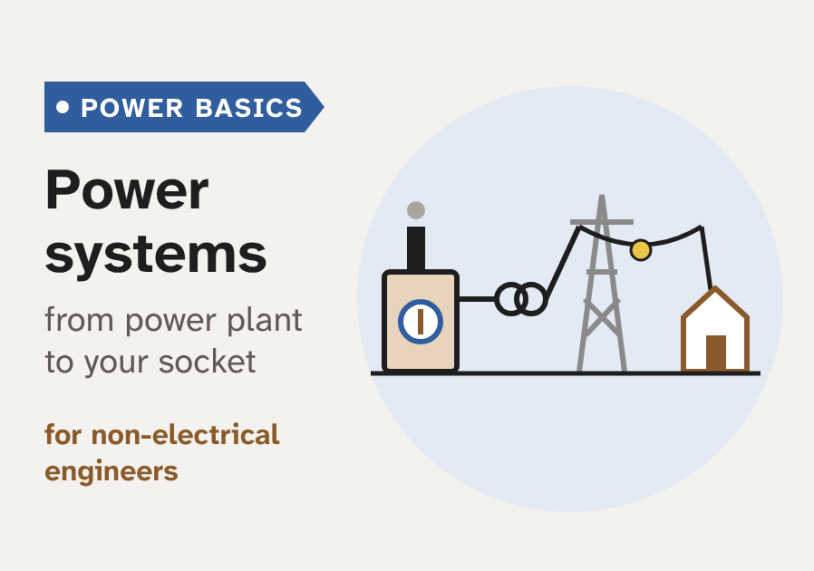
In this guide we follow electricity from the power plant to the socket, with simple animated diagrams, and meet each main part of the grid on the way.
Quick answer: A power system makes electricity in power plants. Transformers raise the voltage, and high-voltage lines carry the power over long distances. Substations then lower the voltage, and distribution lines bring it to homes and factories. Earthing, bonding and protection keep people and equipment safe. Today most new capacity is solar and wind, and this brings new challenges for the grid.
Why power systems matter to non-electrical engineers
Every factory, building and machine depends on electricity. Mechanical, civil, chemical and process engineers meet it every day. They size pumps and motors. They plan buildings around substations. They work next to live equipment.
So a basic picture of the power system helps. It makes work safer. It helps us talk clearly with electrical colleagues. It also helps us cut energy costs.
But the grid can look like a black box. Power plants are far away, and the wires are high up. So how does electricity actually get from a power plant to the socket on the wall? The animation at the top of this page shows the whole journey. In this guide we take it one step at a time.
This is the first article in our power system basics path. It gives the big picture. Later articles go deeper into each part.
Generation: where electricity comes from
Generation means making electricity. Almost every large power plant does it the same way. Something turns a shaft. The shaft spins a generator, a machine that turns motion into electricity. The plants differ only in what turns the shaft.
- Coal. The plant burns coal to boil water. The steam spins a steam turbine, a wheel of blades pushed by the steam. Coal plants give steady power, but they release a lot of carbon dioxide and air pollution.
- Natural gas. A gas turbine works much like a jet engine. Burning gas spins the turbine directly. In a combined cycle plant, the hot exhaust then boils water for a second, steam turbine. So the plant gets much more electricity from the same fuel. Gas plants can also start and change output quickly.
- Nuclear. Uranium atoms split in a reactor. This is nuclear fission. It releases heat, and the heat makes steam for a turbine. Nuclear plants give large, steady output with very low carbon emissions. The main concerns are safety and the long-term storage of radioactive waste.
- Hydro. Water falls from a dam or a river and spins a water turbine. Hydro plants can change output in minutes. Some are pumped storage plants. They pump water uphill when power is cheap and release it when power is needed.
- Wind. The wind turns the blades. The blades turn a generator in the nacelle, the housing at the top of the tower. Wind is stronger and steadier higher up, so towers have grown tall. New land-based turbines in the USA had an average hub height of about 103 m in 2023 (US Department of Energy).
- Solar PV. PV means photovoltaic. Sunlight hits cells made of silicon and makes direct current, or DC. An inverter, an electronic converter, then changes the DC into the alternating current, or AC, that the grid uses. Nothing spins.
The figure below compares four of these side by side. Notice the tags at the bottom. Three use a spinning generator. Solar PV does not. We come back to this difference in the last section.
The mix is changing fast. According to IRENA (the International Renewable Energy Agency), renewables made up about 92.5% of all new power capacity added worldwide in 2024. That was 585 GW, mostly solar and wind. But fossil and nuclear plants still produce a large share of the world's electricity. So a modern grid must work well with all of them.
Transmission and distribution, with a worked example
Power plants are often far from the people who use the power. So we need a way to move power over hundreds of kilometres. This is transmission. The last, local part of the journey is distribution.
The key idea is voltage. Voltage is the electrical push. Current is the flow of charge. Power is voltage times current. So we can send the same power with a high voltage and a small current, or a low voltage and a large current.
Think of water in a pipe. Voltage is like the pressure. Current is like the flow. Friction in the pipe wastes energy, and the waste grows quickly with the flow. So to move a lot of energy far, we use high pressure and a small flow. The grid does the same with high voltage and a small current.
Why does a small current matter so much? Every wire has some resistance, R, an opposition to the flow that turns energy into heat. The heat loss is I²R: the current squared, times the resistance. So if we cut the current by 10 times, the loss falls by 100 times.
Worked example. We send 10 MW of three-phase power over a 20 km line. Each phase conductor has a resistance of 2 Ω. For three-phase power, the current is I = P ÷ (√3 × V).
- At 11 kV: I = 10,000,000 ÷ (1.732 × 11,000) ≈ 525 A. The loss is 3 × 525² × 2 ≈ 1.65 MW. That is about 16.5% of the power, lost as heat.
- At 400 kV: I = 10,000,000 ÷ (1.732 × 400,000) ≈ 14.4 A. The loss is 3 × 14.4² × 2 ≈ 1.25 kW. That is about 0.0125%.
The voltage is about 36 times higher, so the current is about 36 times lower. The loss is 36², or about 1300 times lower. The bar chart below shows how big this difference is.
So the grid raises the voltage for the long trip. Then it lowers the voltage in steps for safe local use. The figure below shows the typical levels. A substation is a fenced site with transformers and switches. It joins the different voltage levels together.
- Transmission lines run at about 220 kV to 765 kV. In many countries 400 kV is common. They link large plants and big cities.
- Sub-transmission at about 66 kV to 132 kV feeds regions and very large industrial sites.
- Distribution at medium voltage, often 11 kV to 33 kV, runs along streets to local transformers.
- Low voltage is what we plug into: 230/400 V in most countries, and 120/240 V in North America.
Transformers: changing the voltage
We have seen that the voltage changes many times on the way. The device that does this is the transformer. It has no moving parts. It works only with AC.
A transformer has two coils of wire around an iron core. The input coil is the primary winding. The output coil is the secondary winding. The two coils are not connected by wire.
AC in the primary makes a changing magnetic flux, a magnetic field that flows around the core. The flux passes through the secondary and induces a voltage in it. This is electromagnetic induction. The figure below shows the parts.
The ratio of turns sets the ratio of voltages. If the secondary has fewer turns, the voltage goes down. This is a step-down transformer. If it has more turns, the voltage goes up. This is a step-up transformer, as used at power plants. The current changes the other way, so the power stays almost the same.
Transformers are very efficient. Large power transformers are usually above 99% efficient at rated load. Smaller distribution transformers are a little lower, often around 97% to 99%. The losses come in two kinds:
- Core losses, also called iron or no-load losses. They come from magnetising the core. They are present whenever the transformer is switched on, even with no load.
- Copper losses, also called load losses. They are I²R heat in the windings. They grow with the square of the load current.
Even 1% of a very large flow is a lot of heat. So big transformers need cooling, usually with oil, radiators and fans. Heat is also what ages the insulation. A transformer that runs cool and is well maintained can stay in service for decades.
Some people think transformers create three-phase power. They do not. Three-phase power comes from the generator, which has three sets of windings. A transformer only changes the voltage. For a three-phase system we use a three-phase transformer, or three single-phase units, one per phase.
Generators and motors: one machine, two directions
Generators and motors look alike inside. Both have a stator, the fixed outer part with windings. Both have a rotor, the part that spins. The difference is the direction of the energy.
- A generator turns mechanical energy into electrical energy. A turbine or engine spins the rotor. The rotor's magnetic field sweeps past the stator windings and induces a voltage.
- A motor turns electrical energy into mechanical energy. Current in the stator windings makes a magnetic field. The field pulls the rotor around, and the shaft drives a pump, fan or conveyor.
The figure below shows the same machine twice. Only the arrows change.
Most large power-plant generators are synchronous generators. Their speed is locked to the grid frequency, 50 or 60 Hz. Most industrial motors are induction motors. They are simple, tough and cheap.
Motors use a large share of the electricity in industry. So their efficiency matters. The standard IEC 60034-30-1 sorts motors into efficiency classes such as IE3 and IE4. A higher class wastes less energy as heat. Often the motor's running cost over its life is far larger than its purchase price.
Safety: earthing, grounding and bonding
Electricity can hurt people in two main ways. It can pass through the body and cause a shock. It can also cause fires and burns from arcs and overheating. Good design and good rules control both risks.
Many standards guide this work. IEC standards are used in most countries, for example IEC 60364 for low-voltage installations. IEEE standards are widely used too, for example IEEE 80 for substation grounding. Each country also has its own wiring rules. Examples are AS/NZS 3000:2018 in Australia and New Zealand, BS 7671 in the UK, and the NEC (NFPA 70) in the USA. Following them is usually a legal duty, not just good practice.
Earthing means connecting parts of the system to the ground. In North America the same idea is called grounding. It has two jobs.
- System earthing. We connect one point of the supply, usually the transformer neutral, to earth. This holds the system voltage steady relative to the ground.
- Protective earthing. We connect exposed metal parts, such as an appliance case, to earth through a protective earth wire. If a live wire touches the case, a large fault current flows. The breaker or fuse sees it and disconnects the supply quickly.
Bonding is different. It ties metal parts together, such as water pipes, gas pipes and the building's steel frame. Then they all sit at the same voltage. So a person who touches two of them at once gets no shock. The figure below shows both ideas.
A bird can sit on a high-voltage line and stay safe. Both of its feet are at the same voltage, so no current flows through it. Bonding does the same for people. It puts every metal part we might touch at one voltage.
The earth electrode is the metal rod, plate or buried grid that connects the system to the soil. Its resistance should be as low as practical. Zero ohms is not possible in real soil. Large high-voltage substations often aim for about 1 Ω or less. Smaller sites may accept a higher value. What really counts is that the touch voltage and step voltage stay safe. These are the voltages a person feels between hand and feet, or between two feet, during a fault.
Earthing and bonding are often treated as the same thing. They are not. Earthing gives fault current a path back to the source, so protection can trip. Bonding removes voltage differences between metal parts. A safe installation needs both.
Power quality: keeping the supply clean
Ideal mains voltage is a smooth sine wave at a steady size and frequency. Power quality describes how close the real supply is to that ideal. Poor quality can make equipment trip, overheat or fail early. The figure below shows four common problems.
- Voltage dips, also called sags, are short drops in voltage. A fault elsewhere on the grid often causes them. Starting a large motor can too. A dip can reset computers and drop out contactors.
- Spikes, also called transients or surges, are very short peaks. Lightning and switching cause them. They can damage insulation and electronics. Surge arresters limit them.
- Harmonics are extra waves at multiples of the main frequency. They bend the shape of the wave. Non-linear loads cause them. These are loads such as variable-speed drives, LED drivers, computers and battery chargers. Harmonics add heat in cables, transformers and motors.
A related topic is power factor. Motors and other inductive loads draw reactive power. This is power that flows back and forth without doing useful work. It still loads the cables and transformers. Capacitor banks supply reactive power locally, so the current from the grid falls. But capacitors do not remove harmonics, and they can even make them worse. Sites with many drives often use harmonic filters instead. Active filters are electronic devices that cancel harmonics in real time.
Permanent power quality meters help a lot. They record dips, spikes and harmonics, so we can find the cause before equipment fails.
Protection: finding and clearing faults
Faults will happen. A cable gets damaged, insulation fails, or lightning strikes a line. A fault is an unwanted path for current, such as a short circuit. Fault currents can be many times the normal current. So the job of protection is to find the fault and cut it off in a fraction of a second. It must also leave the healthy parts of the system running.
- Fuses are the simplest device. A thin metal link melts when the current is too high, and this opens the circuit. A blown fuse must be replaced.
- Circuit breakers are switches that can open safely under fault current. Small breakers have a built-in trip. Large breakers open when a relay tells them to. They can then be closed again.
- Protection relays are the brains. They measure current and voltage through instrument transformers and decide when to trip. An overcurrent relay trips when the current stays too high for too long. An earth fault relay watches for current leaking to earth.
A differential relay works in a different way. It protects one defined area, called the protected zone, such as a transformer, busbar or generator. A current transformer (CT) on each side of the zone measures the current on the same phase. The relay compares the current going in with the current coming out.
Think of a guard counting people at the two doors of a room. If the number going in equals the number coming out, all is well. If more people go in than come out, someone is inside. A differential relay counts current the same way.
In normal running, the current in equals the current out. The difference is zero, so the relay stays quiet. This is also true for a fault outside the zone, because the fault current passes straight through. But a fault inside the zone takes current away. Now the current in is larger than the current out. The relay sees the difference and trips at once. The animation below shows both cases.
For a transformer, the relay first corrects for the turns ratio and the winding connection. Only then does it compare the two sides. This makes differential protection fast and very selective. It trips only for faults inside its own zone.
A differential relay does not compare currents between phases. It compares the current entering and leaving a protected zone on the same phase. A difference means a fault inside the zone.
Adding solar and wind: new challenges
Solar and wind are now the largest part of new capacity. They are clean and cheap to run. But they behave differently from the large spinning plants the grid was built around. This creates some real engineering challenges.
- Variability. Solar and wind output follows the weather and the time of day. The grid must balance supply and demand every second. So it needs forecasting, energy storage, flexible plants and stronger links between regions.
- Low inertia. Inertia is the energy stored in the heavy spinning rotors of synchronous generators. It slows down any sudden change in frequency. Solar PV and many wind turbines connect through inverters, so they add little or no natural inertia. With less inertia, frequency changes faster after a large plant trips. Newer grid-forming inverters can imitate inertia with their controls.
- Limited fault current. A synchronous generator can feed about 5 to 10 times its rated current into a fault for a short time. Inverters usually limit their current to about 1 to 1.5 times rated, to protect their electronics (CIGRE, 2026). So some overcurrent relays may not see a fault clearly. Protection settings and schemes must be reviewed as inverter-based plants grow.
- Voltage and power quality. Rooftop solar can push power back up a distribution feeder. This can raise local voltage above the limit. Inverters also inject some harmonics. Modern grid codes ask inverters to help, for example by controlling reactive power to hold the voltage.
None of these problems stop the change. But they explain why grid engineers now talk so much about storage, inverters and protection.
Key takeaways
- A power system has four stages: generation, step-up, transmission, then step-down and distribution.
- Thermal, hydro and wind plants spin a generator. Solar PV makes DC, and an inverter changes it to AC.
- High voltage means low current, and I²R loss falls with the square of the current. That is why transmission runs at hundreds of kilovolts.
- Transformers change voltage by the ratio of turns. Large units are usually above 99% efficient.
- Earthing gives fault current a path so protection trips. Bonding keeps all metal parts at one voltage.
- A differential relay compares current in and out of a zone on the same phase. Renewables bring variability, low inertia and limited fault current.
This article gave the big picture. Next, we suggest learning how the grid is laid out, how a generator stays in step, and what happens during an overload or short circuit. The guides below go deeper.
Related guides on Electrical Blog:
A comprehensive guide to power system topology