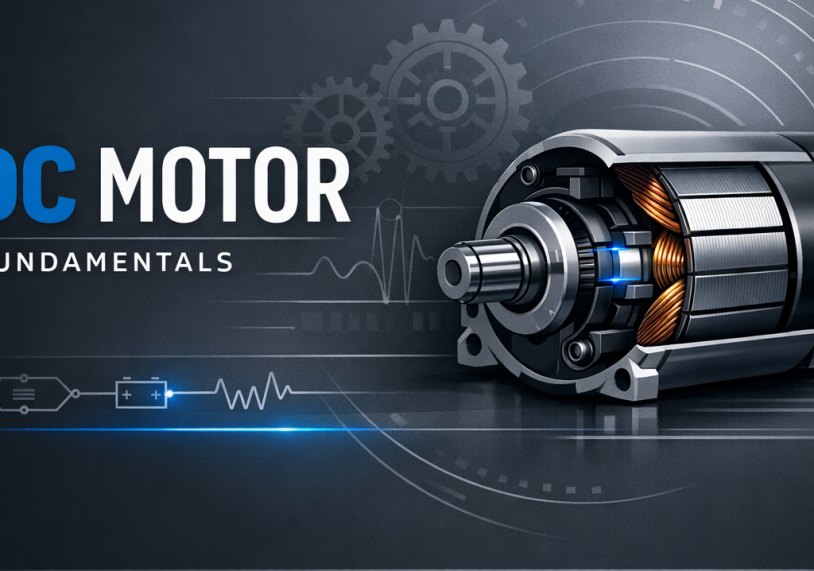
TL;DR (Too Long; Didn’t Read)
- DC motors convert electrical energy to mechanical torque based on the Lorentz Force (current-carrying conductor in a magnetic field). The commutator and brushes mechanically reverse current direction to ensure continuous, unidirectional rotation.
- Back Electromotive Force is the induced voltage that opposes the applied terminal voltage. It is crucial for self-regulating motor speed and limiting the armature current to prevent overload.
- To optimize efficiency and reduce heat loss, the rotor (armature) core is constructed using laminated iron discs to minimize the magnitude of induced eddy currents.
- Motor performance (speed regulation and starting torque) is dictated by its winding topology: Series motors offer high starting torque but poor regulation, while Shunt and Permanent Magnet DC (PMDC) motors provide more stable speed characteristics.
Table of Contents
- A Foundational Review of DC Motor Principles
- The Foundational Physics of the DC Motor
- Anatomy and the Mechanism of Commutation
- Operational Characteristics and Governing Equations
- Review of Classic DC Motor Topologies
- Bridging Foundational Knowledge to Modern Control Systems
- Frequently Asked Questions
Re-establishing the Foundation: Why Core DC Principles Endure
While contemporary industrial drives and high-performance applications increasingly favor brushless DC (BLDC) and AC induction motors, the foundational physics and engineering principles of the classic brushed DC motor remain essential for robust system analysis.
Understanding the fundamental working principle of the traditional DC motor provides the crucial theoretical framework necessary to diagnose commutation issues, analyze torque ripple, and appreciate modern drive control methodologies.
This refresher serves as a comprehensive review, stripping away application specifics to focus solely on the core mechanics by which these machines convert electrical energy into predictable mechanical energy, a process rooted in electromagnetism.
The Foundational Role of Electromagnetism
The operation of any rotating electrical machine, including the fundamental DC motor, relies on the precise interaction between magnetic fields and current flow. This interaction produces the rotational force required for the conversion process.
We begin by revisiting the core concept that an electrical current flowing through coil windings immersed in a static electromagnetic field experiences a perpendicular force. This is the fundamental mechanism that drives the rotor (or armature) within the stator assembly.
Crucially, the generation of Electromotive Force (EMF), often termed back EMF, is intrinsic to this operation, governing the speed-torque relationship and overall performance characteristics of the machine. This foundational understanding is critical for anyone designing or troubleshooting motor control systems, from simple toy cars to advanced industrial cooling fans or power tools.
A Foundational Review of DC Motor Principles
The contemporary landscape of electromechanical drive systems increasingly favors high-efficiency alternating current (AC) induction and brushless direct current (BLDC) machines. Despite this industrial shift, the foundational physics and engineering principles governing the traditional brushed DC motor remain indispensable for rigorous system analysis and diagnosis of complex system faults as well as control theory.
Understanding precisely how the direct current machine converts electrical energy into continuous, unidirectional mechanical energy is crucial. This knowledge is not merely historical, it informs the diagnosis of complex system faults and the optimization of performance in legacy industrial machinery and specialized low-voltage applications, such as high-precision power tools or embedded systems utilizing small cooling fans and actuators.
This review serves as a definitive, instructional resource, designed to solidify the core physics, anatomy, and performance characteristics that define the DC motor. We begin by revisiting the fundamental laws that translate voltage potential difference into rotational torque.
The Foundational Physics of the DC Motor
The fundamental working principle of the DC motor relies on the precise interaction described by three interconnected electromagnetic concepts: the Lorentz Force, Faraday’s Law of Induction, and Fleming’s rules. These laws collectively define the motor effect, enabling the device to convert electrical energy into mechanical energy through controlled magnetic interaction.
Understanding these laws is critical for analyzing the machine’s steady-state operation and transient performance characteristics.
Anatomy and the Mechanism of Commutation
The practical application of the Lorentz Force to generate continuous rotation requires a precisely engineered mechanical structure. A brushed DC motor is fundamentally defined by its two primary functional parts: the stationary field structure (the stator) and the rotating element (the rotor, or armature).
Understanding the architecture of these parts of a DC motor is essential for analyzing how the machine handles the conversion of electrical energy to mechanical energy.
Stator, Rotor, and Armature Construction
The stator component is responsible for establishing the primary magnetic field lines. In smaller applications, such as toy cars or cooling fans, this field is often provided by high-strength permanent magnets.
In larger, wound-field industrial machines, the stator utilizes electromagnets created by dedicated field windings. The resulting magnetic field lines provide the necessary flux density for interaction with the current-carrying armature coils.
The rotor component, known as the armature, is the rotating element mounted directly on the shaft. This element houses the coil windings that carry the electrical current supplied by the external battery or power source.
Rotor Construction and Eddy Current Mitigation
To maximize efficiency, the armature core is constructed from stacked, thin laminated iron discs. This lamination is critical to minimize energy loss caused by induced eddy currents within the core material.
Research confirms that the thinner the lamination of these discs, the smaller the magnitude of the resulting eddy current, significantly improving the overall machine efficiency and reducing heat generation. The copper wire windings are seated within slots in this laminated core.
Demystifying Commutation for Continuous Torque
The defining characteristic of the brushed DC motor is the commutator and electrical brush contact assembly. This mechanism is crucial for ensuring the rotational force remains unidirectional.
The commutator segments are segmented copper plates mounted on the shaft, electrically insulated from one another, and connected directly to the armature coil windings. The stationary brushes, typically carbon blocks, maintain sliding contact with these segments.
The brushes facilitate the transfer of the input electrical current (following the conventional current direction) from the external supply to the rotating armature circuits.
The Working Principle of Current Reversal
The fundamental working principle relies on the precise timing of current reversal. As the armature rotates, the current direction in each coil must be reversed exactly as that coil passes the neutral plane (the point where the coil is parallel to the magnetic field lines and produces zero torque).
The segmented design of the commutator mechanically performs this reversal of current flow. By switching the connection path every half-rotation, the torque applied to the rotor remains continuous and prevents the motor from oscillating instead of rotating.
Electromagnetic Field Generation and Force Direction
The current passing through the armature coil windings generates a strong electromagnetic field. The magnitude of the resulting force is directly proportional to the strength of this armature field and the flux density of the permanent magnetism provided by the stator.
To achieve smoother rotation and consistent torque output, the armature utilizes multiple coils rather than a single loop. Professional designs often employ three or more sets of coils, positioned at calculated angles, such as 120 degrees apart in common configurations.
Increasing the number of coils significantly enhances rotational stability and minimizes the torque ripple experienced during the commutation process.
Applying Fleming’s Left Hand Rule
The resulting force that drives the rotation is precisely predicted by Fleming’s Left Hand Rule. This rule dictates the spatial relationship between the magnetic field lines, the direction of the current flow, and the resulting mechanical force.
In the context of the DC motor, the first finger indicates the magnetic field direction (North to South), the second finger indicates the direction of the electrical current in the coil, and the thumb indicates the direction of the mechanical force (motion).
The commutator ensures that as the coil rotates, the current direction is switched relative to the magnetic field, maintaining the direction of the force (the thumb) and ensuring continuous rotation, thereby perfecting the electrical energy to mechanical energy conversion.
Operational Characteristics and Governing Equations
The transition from mechanical anatomy to dynamic performance requires a rigorous understanding of the motor’s core operating principles. The performance of a DC motor is fundamentally dictated by the interaction of applied voltage, generated torque, and rotational speed. These relationships are governed by two foundational expressions: the Back Electromotive Force (EMF) equation and the mechanical torque equation.
Back Electromotive Force (Ea) and Speed Regulation
As the rotor component (armature) rotates, its coil windings cut through the static magnetic field produced by the stator. According to Faraday’s Law of Induction, this relative motion induces a counter-voltage within the armature conductors known as Back Electromotive Force (Back EMF), denoted as Ea. This induced voltage always opposes the applied terminal voltage Vt.
The magnitude of the back EMF is directly proportional to the field flux and the rotational speed:
Ea=KeΦωEa = Ke \Phi \omega
where:
Ea = Back EMF (volts)
Ke = motor design constant
Phi = field flux (webers)
omega = angular speed (radians per second)
The presence of Ea is essential for the self-regulation of a DC motor. The armature circuit voltage equation defines the net voltage driving the armature current Ia:
Vt=Ea+IaRaVt = Ea + Ia Ra
where:
Vt = terminal voltage
Ia = armature current
Ra = armature resistance
When the motor speed increases, Ea also increases. This reduces the effective voltage across the armature resistance Ra, thereby limiting the armature current Ia drawn from the supply. Conversely, when the motor slows down under load, Ea decreases, allowing more current to flow and producing higher torque.
This automatic adjustment of current through back EMF prevents excessive current, avoids thermal overload, and provides inherent speed regulation under varying load conditions.
The Torque Equation and the Speed-Torque Curve
The torque developed (T) is the mechanical output of the motor, produced by the interaction between the magnetic field flux and the current-carrying conductors in the armature. This electromagnetic interaction is the fundamental mechanism by which a DC motor converts electrical energy into mechanical energy.
The developed torque is directly proportional to the field flux and the armature current:
T=KtPhiIaT = K_t Phi I_a
where:
T = developed torque (N-m)
Kt = torque constant
Phi = field flux (webers)
Ia = armature current (amperes)
The torque constant Kt is numerically equal to Ke when SI units are used.
This relationship shows that achieving high starting torque, especially during acceleration or under heavy load conditions, requires a high initial armature current.
The characteristic speed-torque curve is a vital performance metric derived from these governing equations. For a fixed terminal voltage, this curve illustrates the near-linear relationship where speed decreases as the mechanical load torque increases. Understanding this curve is paramount for matching a DC motor to its specific load requirements, such as in Power Tools or industrial applications.
Rotor Construction and Efficiency: Managing Eddy Currents
While the equations define the ideal performance, the physical construction of the Rotor Component (Armature) dictates the motor’s real-world efficiency. The armature core is not constructed from a solid block of iron but uses Laminated Iron Discs.
These laminations are thin sheets of iron, insulated from one another, stacked along the Shaft. This construction is necessary to reduce energy losses caused by induced Eddy Currents.
As the armature rotates in the Electromagnetic Field Generation area, the core itself acts as a conductor, inducing unwanted parasitic currents. These Eddy Currents generate heat, reducing the motor’s overall efficiency. By using thinner laminations, the magnitude of the Eddy Current loops is significantly decreased, thus minimizing core loss.
Optimizing the arrangement and number of Coil windings also enhances performance. Multiple coils, often positioned 120 degrees apart in the armature, ensure a smoother transition during commutation and maintain a more consistent Electromagnetic Field, resulting in smoother rotation and reduced torque ripple.
Review of Classic DC Motor Topologies
The operational profile of a DC motor is fundamentally determined by the method used to establish the field flux ($Phi$). This classification hinges on how the field windings are electrically connected relative to the armature windings. This configuration dictates the motor’s torque production, speed regulation, and overall stability during the process of converting electrical energy into mechanical energy.
While all configurations utilize the core structure, the armature (rotor), the stator, and the commutator assembly, their distinct winding arrangements result in dramatically different performance characteristics.
| Motor Type | Field Winding Connection | Performance Characteristics |
|---|---|---|
| Series Motor | The field windings are connected in series with the armature. | Highest starting torque, poor speed regulation. Presents a critical risk of runaway speed under no-load conditions. Suited for high-inertia loads like traction and hoisting. |
| Shunt Motor | The field windings are connected in parallel (shunt) across the armature terminals. | Features a constant speed characteristic due to stable field flux. Offers excellent speed regulation. Ideal for applications requiring steady speeds, such as machine tools. |
| Compound Motor | Incorporates both series and shunt coil windings. | A blend of characteristics, offering high starting torque (series component) and improved speed stability (shunt component). Variations include cumulative and differential compounding. |
| Permanent Magnet DC (PMDC) Motor | Field flux is provided by permanent magnets embedded in the stator. | Offers high efficiency, compact size, and a highly linear speed-torque curve because the magnetic field ($Phi$) remains constant, independent of the electrical current supplied. |
Operational Consequences of Winding Connections
The unique connections between the field and armature dictate the motor’s dynamic response to load changes. In a Series DC motor, the field current and the armature current are identical.
Since the electromagnetic field flux is proportional to the field current, and torque is proportional to the product of flux and armature current, the resulting torque becomes proportional to the square of the line current (before magnetic saturation):
T∝I2T \propto I^2
This squared relationship is the source of the Series DC motor’s extremely high starting torque, making it indispensable for heavy starting loads. However, under no-load conditions, the armature current drops drastically, causing the field flux to fall to a low value. To maintain the balance imposed by the back EMF equation, the rotational speed must increase rapidly, leading to the well-known runaway risk associated with Series DC motors.
Conversely, the Shunt DC motor maintains a nearly constant electromagnetic field flux because its field windings are connected directly across the constant supply voltage. Since the field current is largely independent of the armature current, the developed torque becomes approximately linear with armature current:
T∝IaT \propto I_a
This stability of the magnetic field results in excellent speed regulation. Shunt DC motors are therefore well suited for applications requiring nearly constant speed under varying load conditions, as the field flux remains stable, in sharp contrast to the load-dependent flux of Series DC motors.
The Role of Permanent Magnets in DC Motor Operation
The Permanent Magnet DC (PMDC) motor represents a simplification of the shunt topology, replacing the field coil windings with permanent magnets in the stator component. This design eliminates the need for field current entirely, reducing copper losses and enhancing overall efficiency.
Because the magnetic field is fixed, the performance curve is highly linear. This simplicity and efficiency make PMDC motors ubiquitous in low-power applications such as toy cars, power tools, and cooling fans, where the battery supplies the electrical current for the rotor (armature) windings.
Bridging Foundational Knowledge to Modern Control Systems
Mastering the fundamental understanding of how the DC motor works provides the necessary analytical framework for advanced motor drive challenges, and effectively design feedback control loops for precise motion control.
Frequently Asked Questions
How does a DC motor convert electrical energy into mechanical energy?
The fundamental working principle of the DC motor involves the conversion of electrical energy to mechanical energy via electromagnetic interaction. This phenomenon relies on the Lorentz Force acting on current-carrying conductors within a magnetic field.
The static magnetic field is established by the stator component, utilizing either permanent magnetism or field electromagnets. This field interacts with the strong electromagnetic field generation created when electrical current flows through the coil windings embedded in the rotating rotor component (armature).
The resulting force vector, dictated by Fleming’s Left Hand Rule for Motor Operation, generates continuous rotational torque on the shaft. This interaction between the static magnetic field lines and the current flow is the core mechanism by which the DC motor operates.
What is the purpose of the commutator and brushes in a DC motor?
The commutator assembly, alongside the electrical brush contact system, is critical for achieving continuous, unidirectional rotation. It functions as a mechanical rectifier, ensuring the torque applied to the armature remains consistently in one direction.
The commutator segments reverse the direction of the conventional current direction flowing through the coil windings. This reversal of current flow occurs precisely when the coil passes the neutral magnetic axis, which is essential to sustain rotation and prevent the coil from simply oscillating.
The brushes maintain the necessary electrical connection, feeding the required voltage potential difference to the rotating armature circuits. Understanding the operation of the commutator segments and brushes is key to analyzing DC motor maintenance requirements.
Why are laminated iron discs used in the rotor construction?
The rotor component utilizes laminated iron discs specifically to mitigate energy losses attributed to eddy currents. As the armature rotates through the static magnetic field, voltages are induced in the core material itself, causing parasitic circulating currents.
By constructing the core from thin, insulated laminations instead of a solid mass, the effective resistance to these circulating currents is significantly increased. Thinner laminations directly correlate to smaller eddy current magnitude, minimizing power dissipation and substantially improving overall motor efficiency.
What is Back Electromotive Force (EMF) and why is it important?
Back Electromotive Force (EMF) is a voltage induced in the armature windings according to Faraday’s Law of Induction, which fundamentally opposes the applied terminal voltage. This induced voltage is directly proportional to the motor’s speed and the field flux.
Back EMF is crucial because it acts as a natural governor, limiting the armature current drawn from the source. As the speed increases, the Back EMF rises, effectively reducing the net voltage across the armature circuit resistance.
This mechanism provides inherent speed regulation and prevents the DC motor from drawing excessive electrical current under normal operating conditions, thereby protecting the motor windings.