Quick answer: A STATCOM is a shunt device that supports the grid voltage. STATCOM stands for Static Synchronous Compensator. It uses power electronics to act like a controllable source of reactive power. When it makes its own voltage higher than the grid, it pushes reactive power into the grid and the voltage rises. When it makes its voltage lower, it pulls reactive power out and the voltage falls.
What problem does a STATCOM solve?
An AC grid needs steady voltage. When a large load switches on, the voltage can sag. When the load drops, the voltage can rise too high. Both are a problem.
The grid controls voltage using something called reactive power. Reactive power is the part of electricity that does no real work. But the grid still needs it to hold the voltage up. Add reactive power, and the voltage rises. Remove it, and the voltage falls.
So the grid needs a device that can add or remove reactive power quickly. So how does a STATCOM do this — without any large spinning machine or big bank of switched capacitors?
What is inside a STATCOM?
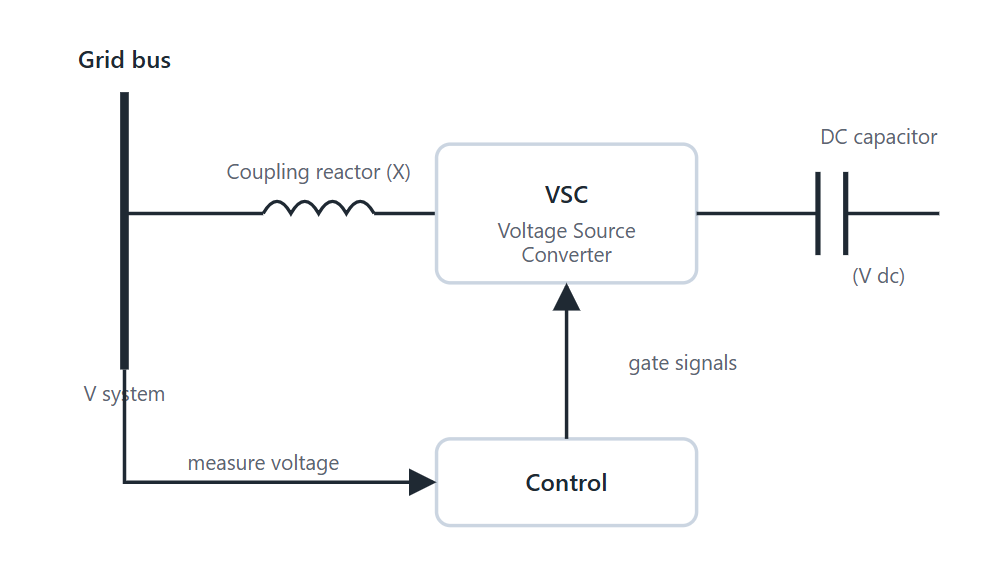
A STATCOM has four main parts. We connect it in parallel with the line, between the grid and the ground.
The four main parts, and how the control links them.
Here is what each part does:
The Voltage Source Converter (VSC). This is the heart of the STATCOM. It uses fast electronic switches called IGBTs. It builds a three-phase AC voltage from a DC supply. It can set this voltage to almost any value we want.
The DC capacitor. This sits on the DC side of the converter. It holds a steady DC voltage for the converter to work from. It does not supply real power for long. Its job is to keep the DC side stable.
The coupling reactor. This connects the converter to the grid. It is a small opposition to the flow, and it lets us control the current smoothly. Often the leakage reactance of a coupling transformer does this job.
The control system. This watches the grid voltage all the time. It then tells the converter what voltage to make. This is the part that makes the STATCOM smart and fast.
The main idea: a controllable voltage source
Here is the key idea. Think of the STATCOM as a voltage source that we can adjust. It sits behind the coupling reactor. On the other side of the reactor is the grid voltage.
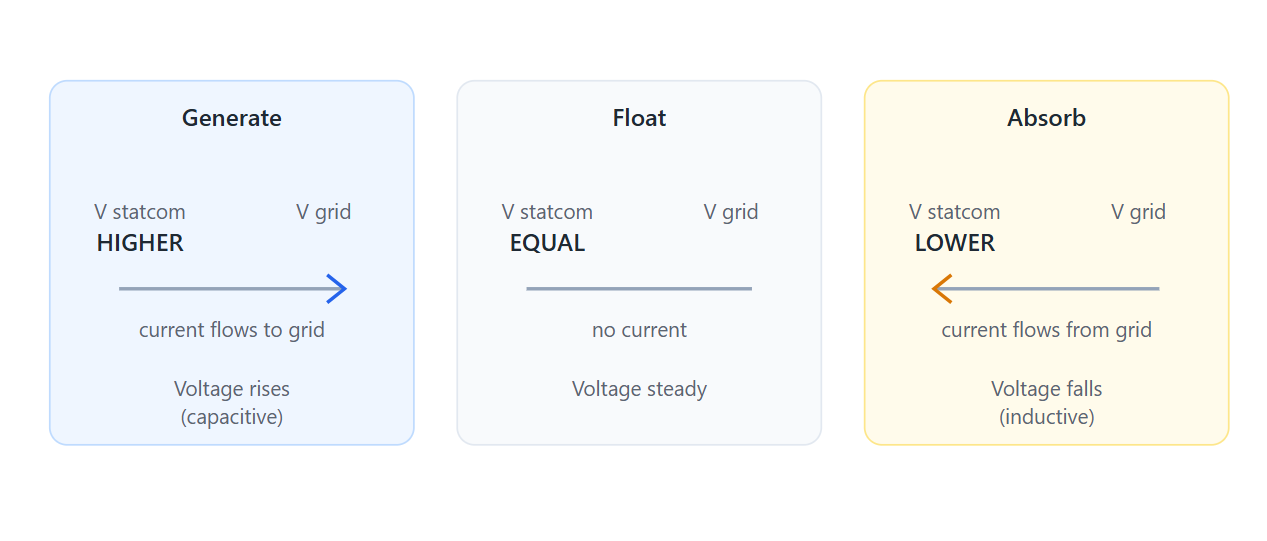
Reactive power flows because of the difference between these two voltages. This gives us three simple cases.
The STATCOM sets its own voltage. The difference from the grid voltage decides what happens.
Case 1 — the STATCOM voltage is higher than the grid. Current flows from the STATCOM to the grid. The STATCOM sends reactive power into the grid. The grid voltage rises. We call this capacitive mode.
Case 2 — the two voltages are equal. No current flows through the reactor. No reactive power moves. The STATCOM simply waits.
Case 3 — the STATCOM voltage is lower than the grid. Current flows from the grid into the STATCOM. The STATCOM absorbs reactive power. The grid voltage falls. We call this inductive mode.
So the STATCOM does not “store” a large amount of energy. It only changes its own voltage. That small change moves reactive power in or out.
How the control works, step by step
The control system repeats a simple loop, many times per second. This is why the STATCOM reacts so fast.
The control loop never stops. It keeps the voltage close to the target.
The loop is easy to follow. First, the control measures the grid voltage. Then it compares this to the target value. If the voltage is too low, it raises the converter voltage, and the STATCOM generates reactive power. If the voltage is too high, it lowers the converter voltage, and the STATCOM absorbs reactive power. Then it starts again.
Why a STATCOM is better at low voltage
This is the most important strength of a STATCOM. It matters most during a fault, when the grid voltage drops very low.
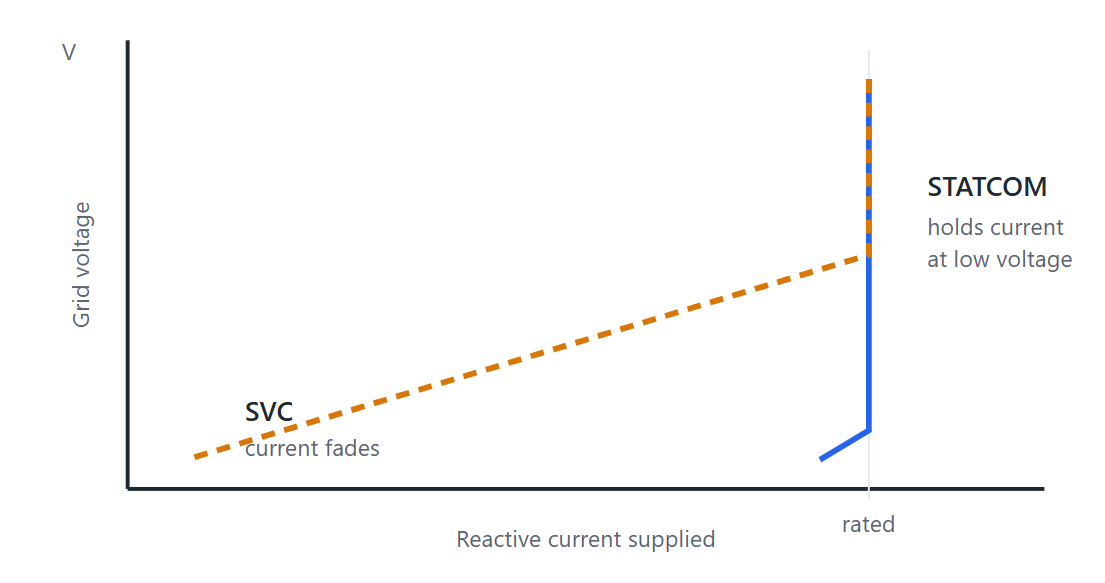
An older device, the SVC (Static VAR Compensator), uses switched capacitors. Its support comes from those capacitors. But a capacitor gives less reactive power when the voltage is low. So when the grid needs help the most, the SVC gives less.
A STATCOM behaves like a current source. It can hold its reactive current almost constant, even when the voltage is low. So it keeps supporting the grid during a deep sag. The diagram below shows this difference.
As the grid voltage drops, the STATCOM keeps giving current. The SVC fades away.
A STATCOM has other benefits too. It reacts in milliseconds. It is smaller than an SVC of the same rating. But it usually costs more. We compare the two in detail in a separate guide, linked below.
Where are STATCOMs used?
STATCOMs are common in these places. They support weak grids that struggle to hold a steady voltage. They sit near large industrial loads that change quickly, such as steel arc furnaces. And they help wind farms and solar plants stay connected during a voltage dip, which the grid code often requires.
Key takeaways
A STATCOM is a shunt FACTS device that controls voltage using reactive power.
Its heart is a Voltage Source Converter, fed by a DC capacitor, linked to the grid through a coupling reactor.
It sets its own voltage. A higher voltage generates reactive power; a lower voltage absorbs it.
A fast control loop keeps the grid voltage near the target, many times per second.
Its big advantage: it keeps supplying reactive current even when the grid voltage is low.